You do not need a gym membership or heavy barbells to build muscle; research shows that training with your own body weight to the point of fatigue produces equivalent muscle growth to lifting weights. This guide covers the science of bodyweight hypertrophy, how to apply progressive overload at home, and a practical weekly routine to help you get stronger safely. Always check with your doctor before starting a new exercise routine, especially if you have underlying health conditions or are recovering from an injury.
The Science of Building Muscle at Home
It is a common misconception that you must lift heavy iron to see changes in your physique. In reality, your muscles do not know the difference between a metal dumbbell and your own body weight; they only understand tension and effort.
Muscle growth, known as hypertrophy, occurs when the rate of protein synthesis exceeds protein breakdown in your muscle tissues. According to experts at Muscle and Motion, this process is driven by three primary mechanisms: mechanical tension (the physical stress placed on muscles during a movement), metabolic stress (the biochemical challenge of producing energy during exercise), and muscle damage (microscopic tears in the muscle fibers that repair stronger). When you perform bodyweight exercises, you initiate a cascade of chemical reactions that promote the production of new proteins, leading to increased muscle mass.
The evidence supporting this is robust. A randomized controlled trial highlighted by FitCraft found that performing push-ups produced “similar pectoralis and triceps hypertrophy as bench press” results over an eight-week period. Furthermore, a meta-analysis of 21 studies confirmed that low-load training performed to the point of failure yields equivalent muscle growth to heavy lifting.
When you perform these movements, you trigger vital neural adaptations. As certified strength and conditioning specialist Tom Holland explains, "When we engage in resistance training, we teach our bodies to “recruit more muscle fibers and do so more quickly”." This means that even without adding external weight, your nervous system becomes more efficient at activating the muscle you already have, which is the first major step in building visible strength.
How to Apply Progressive Overload Without Weights
AI illustration · Peachy Healthy
To continue building muscle, you must apply the principle of progressive overload. This concept, which dates back to the ancient Greek legend of Milo of Croton carrying a growing calf until it became a full bull, involves systematically increasing the demands on your musculoskeletal system. In modern exercise science, it was formalized by Dr. Thomas Delorme to rehabilitate soldiers, and it remains the backbone of all strength training today.
In a traditional gym, progressive overload usually means simply adding more weight to the bar. At home, you need to get creative to keep challenging your muscles. "Building strength is about working smarter, not just harder, and “bodyweight training proves you don’t always need equipment” to feel stronger and more capable."
Here is how you can progressively overload your bodyweight routine compared to a traditional gym setup:
| Method of Overload | Traditional Gym Approach | Bodyweight Home Approach |
|---|---|---|
| Increase Load | Add 5 lbs to the barbell. | Shift to a harder variation (e.g., standard push-up to decline push-up). |
| Increase Volume | Add an extra set of 10 reps. | Add an extra set, or push your current sets closer to muscular failure. |
| Tempo & Tension | Lift the weight at a normal pace. | Refine your form and slow the exercise down to increase time under tension. |
| Rest Periods | Rest 2 minutes between heavy sets. | Shorten rest periods to 60 seconds to increase metabolic stress. |
| Range of Motion | Lower the bar to the chest. | Go deeper into the movement (e.g., a deeper bodyweight squat). |
By manipulating these variables, you ensure that your workouts remain challenging even after a standard bodyweight squat or push-up feels easy.
The Best Bodyweight Exercises for Every Muscle Group
AI illustration · Peachy Healthy
You can target every major muscle group using just your body weight. Experts recommend focusing on compound movements that work multiple joints and muscle groups at once. Here are the most effective foundational exercises:
Upper Body (Chest, Back, Shoulders, Arms)
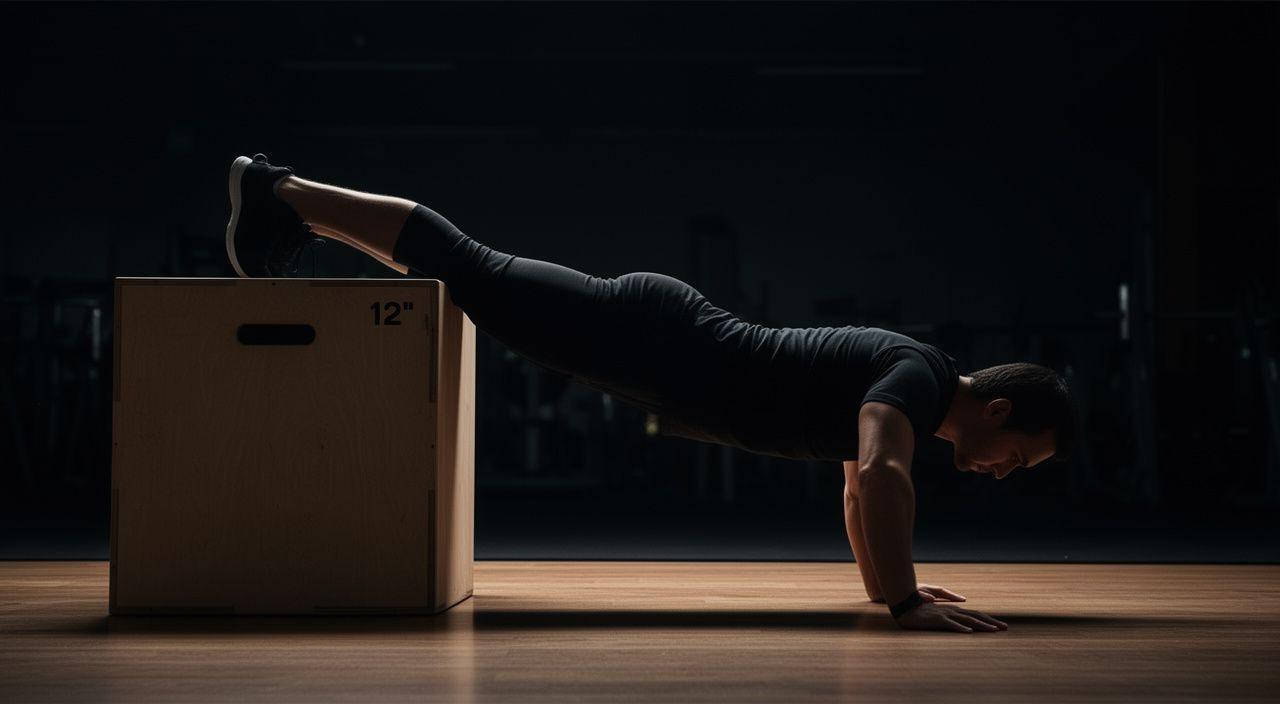
- Push-Ups: A staple for a reason. Push-ups primarily work the chest, shoulders and triceps, while your core stabilizes the movement. Modify them by doing them on an incline (hands on a chair) for beginners, or a decline (feet on a chair) for advanced progressions.
- Pull-Ups and Chin-Ups: If you have a sturdy bar, these are unmatched for back and bicep development. To perform them correctly, you must grasp the handles firmly with a full grip. If you cannot do a full pull-up yet, use a chair for assistance or focus on "negatives" (lowering yourself as slowly as possible).
- Triceps Dips: Using a sturdy chair or the edge of a sofa, lower your body by bending your elbows and push back up to target the back of your arms.
Lower Body (Quads, Hamstrings, Glutes, Calves)
- Bodyweight Squats: Excellent for the quads and glutes. Keep your chest lifted, push your hips back, and bend your knees. You can enhance strength by exploring the science of single-leg variations like Bulgarian split squats to double the difficulty without adding weight.
- Lunges: Forward, reverse, and walking lunges build unilateral leg strength and improve balance.
- Glute Bridges: Lying on your back with knees bent, push your hips to the ceiling. This isolates the glutes and hamstrings effectively.
Core
- Planks and Plank-Ups: Hold a straight-arm or forearm plank to build isometric core strength. Transitioning from a forearm plank to a push-up position (plank-ups) adds dynamic movement to challenge your stabilizers.
If bodyweight alone is no longer providing enough resistance, you can easily use household items like filled water jugs or backpacks, or invest in a simple set of resistance bands to add external tension.
A Practical Weekly Workout Plan for Beginners

AI illustration · Peachy Healthy
Consistency is the most critical factor in muscle building. Research indicates that strength training at least 2 days a week is ideal for growing muscle in beginners.
Before you begin, always complete a warm-up. Five minutes of brisk walking or light jogging will raise your core temperature and prepare your joints for the work ahead.
Here is a simple, balanced three-day full-body routine you can do in your living room:
Day 1: Full Body Strength A
- Bodyweight Squats: 3 sets of 10–15 reps
- Push-Ups (incline or standard): 3 sets of 8–12 reps
- Reverse Lunges: 3 sets of 10 reps per leg
- Plank: 3 sets of 30–45 seconds
Day 2: Active Recovery
- Light walking, stretching, or gentle yoga to promote blood flow and recovery.
Day 3: Full Body Strength B
- Glute Bridges: 3 sets of 15 reps
- Chair Triceps Dips: 3 sets of 10–12 reps
- Bodyweight Squats (slow tempo): 3 sets of 10 reps
- Pull-Ups or Doorway Rows: 3 sets to near failure
Day 4: Active Recovery
- Rest or light mobility work.
Day 5: Full Body Strength C
- Decline Push-Ups (feet elevated): 3 sets of 8–10 reps
- Forward Lunges: 3 sets of 10 reps per leg
- Plank-Ups: 3 sets of 10 reps
- Calf Raises (standing on a step): 3 sets of 15–20 reps
Days 6 & 7: Rest and Recover
- Muscles grow during rest, not during the workout itself. Ensure you are getting adequate sleep and nutrition to support tissue repair.
Practical Takeaways for Your Home Routine
To ensure you stay on track and continue seeing results, keep these core principles in mind:
- Train close to failure: Since you are not using heavy weights, you must push your sets until the last few repetitions feel genuinely difficult. This is what triggers metabolic stress and muscle growth.
- Track your progress: Keep a simple notebook or use your phone to log your reps and sets. When an exercise becomes easy, change the tempo, add a rep, or switch to a harder variation.
- Prioritize protein and sleep: Your body needs adequate protein to repair the microscopic muscle tears caused by your workouts, and sleep is when the majority of this recovery occurs. Our guides to how much protein you need and better sleep habits cover both in detail.
- Be patient: Neuromuscular adaptations happen in the first few weeks, making you feel stronger quickly. Visible changes in muscle size (hypertrophy) typically take 8 to 12 weeks of consistent effort.
Frequently asked questions
Can you build muscle without a gym?
Yes, you can absolutely build muscle without a gym. Peer-reviewed research demonstrates that bodyweight exercises performed to the point of muscular failure produce equivalent muscle growth to traditional weightlifting, provided you apply the principle of progressive overload by manipulating reps, tempo, and exercise difficulty.
How to build muscle at home without equipment for beginners?
Beginners should start with foundational compound movements like bodyweight squats, modified push-ups (such as incline push-ups against a wall or chair), glute bridges, and planks. Aim to train two to three times per week, focusing on mastering your form before increasing the number of repetitions or slowing down the tempo to make the exercises harder.
Can you build muscle without weights for females?
Yes, the physiological mechanisms of muscle hypertrophy and neuromuscular adaptation apply equally to all adults, regardless of gender. While hormonal differences mean women may not build the same absolute muscle mass as men, bodyweight training is highly effective for women to increase lean muscle tissue, improve bone density, and enhance overall metabolic health.
Related articles